

Google Ads is rolling out a Spend Benchmarks report that compares an advertiser's weekly spend and clicks against a peer group Google defines by industry and advertising location, appearing directly in the Account Overview. The report can surface alongside Google's own recommendations to increase spending, which raises an obvious question worth asking before adjusting a single budget: is a company that sells advertising the right one to tell you whether you're buying enough of it?
What the Report Actually Shows, in the One Example Public So Far
The feature isn't yet documented in Google Ads Help, so the only real look at it comes from a screenshot paid-search specialist Thomas Eccel posted publicly. In his example, the report showed weekly spend of €284 against a peer figure of €268, about 6% more, alongside 912 clicks against a peer figure of 765, about 19% more. Worked through, that puts the advertiser's implied cost-per-click at roughly €0.31, versus about €0.35 for the peer group, meaning the account shown was already buying clicks more efficiently than its peers, not less.
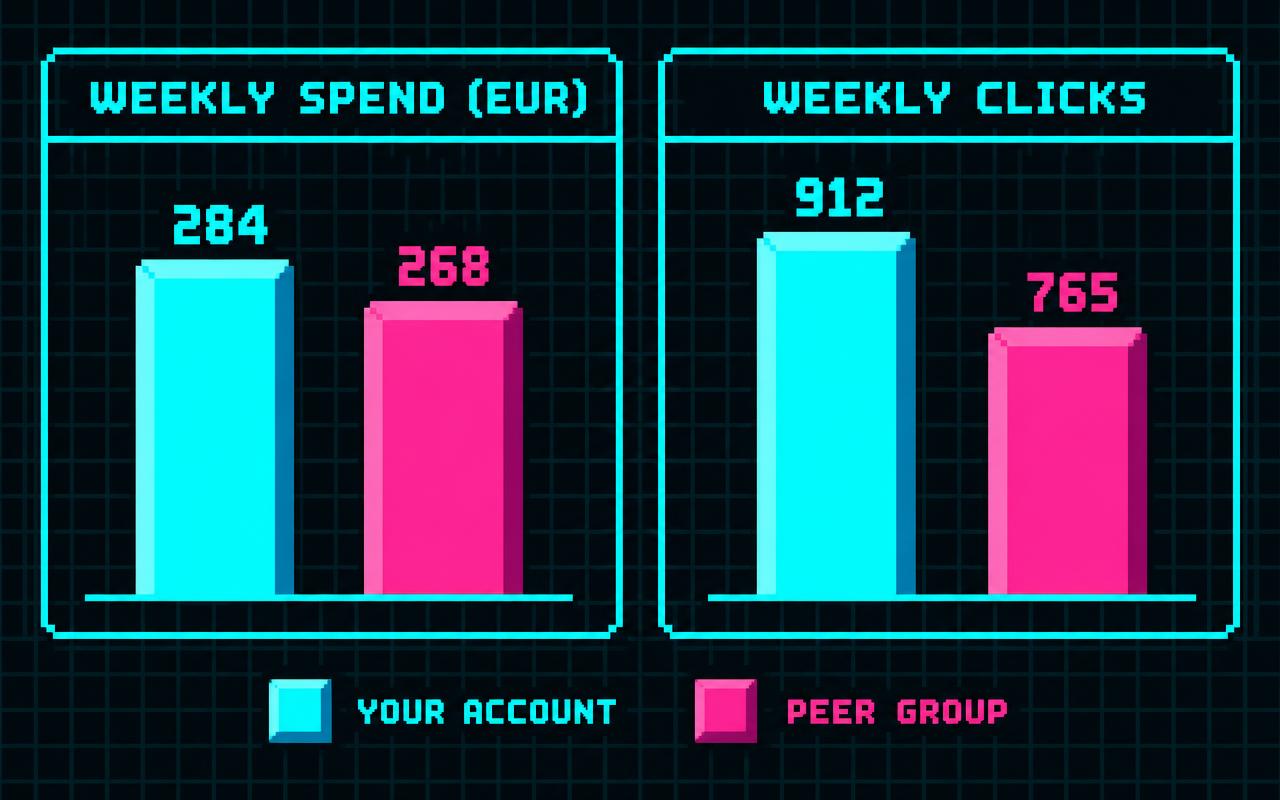
That detail matters more than it might seem. An advertiser glancing at "you're spending 6% more than peers" could easily read that as a signal to pull back, or Google's accompanying spend-increase recommendation could push the opposite way, read it as a signal to add budget. Neither reaction accounts for what the report actually demonstrated in its own public example: more spend paired with meaningfully cheaper, more efficient clicks. The number alone tells an incomplete story even in the one case anyone's actually seen.
What Peer Spend Can't See, and Why That's the Whole Problem
A peer spend comparison has no visibility into margin, conversion rate, average order value, or customer lifetime value, the numbers that actually determine whether spending more produces a profitable outcome. It also can't measure incrementality: whether the results attributed to that spend would have happened anyway, from organic traffic, direct visits, or brand searches that don't need the extra ad dollars to convert. Two businesses in the same industry, in the same city, spending the same weekly amount, can have completely different unit economics, one might be printing money at that spend level, the other losing money on every conversion. A peer benchmark built from industry and location alone has no way to tell those two businesses apart.
This is why we tie paid media reporting to pipeline and revenue rather than platform-side ratios. A benchmark that can't see your margin can't tell you whether your spend is working.
The Methodology Nobody Can Verify
Google hasn't published how many accounts make up a given peer group, what specifically defines "similar," or whether an advertiser can see and correct their own categorization if it's wrong. That's not a small gap. A benchmark is only as useful as the group it's drawn from, and right now advertisers are being shown a comparison they have no way to audit, they can't check whether their "peers" are genuinely comparable businesses or a broader, noisier group that happens to share an industry code and a metro area.
What to Actually Check Before Reacting to This Number
If a Myrtle Beach business owner sees this report and it suggests spending more, the right response isn't to accept or dismiss the number, it's to check what the report can't. Look at actual conversion rate and cost per acquisition against real profit margin, not against a peer figure with unknown provenance. Ask whether current spend is already capturing available demand or whether more budget would extend into lower-quality clicks. And treat a Google-generated recommendation to spend more with the same scrutiny you'd apply to any sales pitch, because functionally, that's what it is, a company that profits from higher spend is the one presenting the case for it.
FAQ: Should I Increase My Google Ads Budget Because of a Spend Benchmarks Recommendation?
Not based on the benchmark alone. The Spend Benchmarks report compares weekly spend and clicks against a peer group defined by industry and location, but it has no visibility into profit margin, conversion quality, or whether results would have happened without the added spend. A legitimate reason to increase budget is evidence that current campaigns are profitable and under-served demand exists, for example, ads getting cut off early in the day due to budget caps while still converting well. A peer comparison showing you're spending less than similar businesses is not, by itself, that evidence. Treat the benchmark as one data point for context, and let actual account performance and profitability decide the budget, not a percentile ranking against businesses you can't independently verify are truly comparable.
FAQ: Can I See or Correct the Peer Group Google Assigns My Account?
Not as of now. Google has not documented the report in Ads Help, published the number of accounts in a peer group, defined what counts as "similar," or provided a way to review or dispute your categorization. Until that information exists, the comparison should be read as directional context, not a verified benchmark.
The Takeaway
A spend comparison from the platform selling the spend isn't neutral information, even when it's framed as one. The one public example of this report actually proves the point better than any warning could: an account spending more than peers, getting meaningfully cheaper clicks, still got shown a number that could easily be misread as "spend more." Context is useful. A recommendation from the seller isn't the same thing as a decision, that's still yours to make, with your own numbers.
Sources
- Google Ads Help for official feature documentation, which does not yet cover this report
- Thomas Eccel, paid search specialist, for the only public screenshot of the Spend Benchmarks report
- Related reading: Google August 2026 Spam Update and Google Ranking Factors 2026 Survey
Written by Scott Patrick Humphrey, Founder, Get Lifted Agency. Last reviewed September 2026.
Get Lifted Agency manages Google Ads budgets around profitability, not platform-generated pressure to spend more. Let's talk.