
Search intent match rated as the single highest-impact ranking factor in Zyppy's 2026 Google Ranking Factors Expert Survey, ahead of backlinks, content quality, and every one of the 103 other factors 131 SEO professionals evaluated. The survey collected 13,665 individual ratings on a seven-point scale, then asked each respondent to name Google's three most important signals directly, and the results confirm some long-held beliefs while contradicting what Google itself has said publicly about at least one of them.
Search Intent Ranked First, and It's Not About Keywords Anymore
Matching what a searcher actually wants, not just what words they typed, was the top-rated individual factor in the survey. Respondents pointed repeatedly to information gain, whether a page adds something the results already ranking don't, as the practical test of intent match, not keyword density or exact-match phrasing. A page that answers the literal query but nothing beyond it is competing against pages that answer the query and go further, and the survey data says that gap is what separates rankings, not the words on the page.
Backlinks Ranked Second, Which Contradicts Google's Own Public Statements
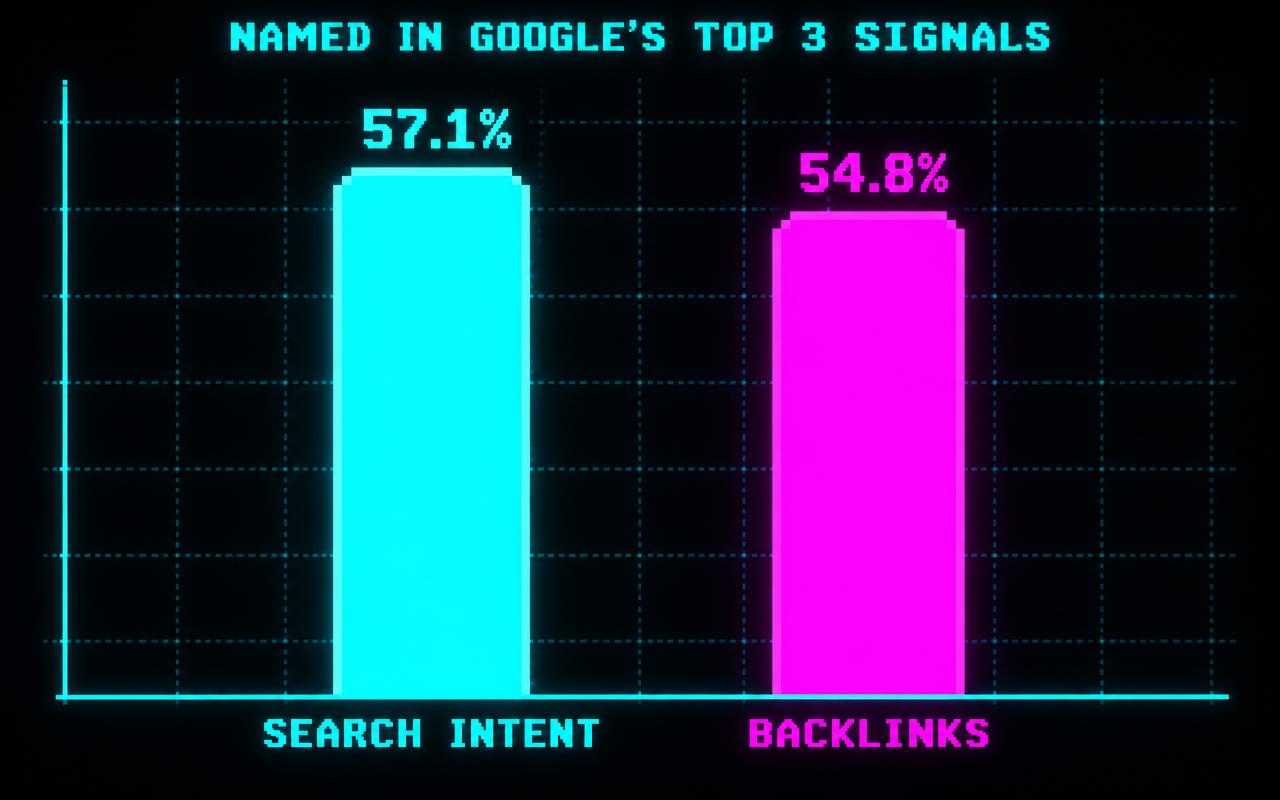
54.8% of respondents named backlinks one of Google's three most important ranking signals, second only to search intent at 57.1%. That's a genuinely interesting tension: Google's own Gary Illyes has said publicly that links aren't among Google's top three ranking signals, yet the practitioners actually running campaigns and watching results rate them second overall. Links from trusted, topically relevant sites with real visitors scored among the highest-rated backlink factors, while spammy links scored among the strongest negative signals in the entire survey. Cyrus Shepard, writing in the report itself, put it bluntly: "the rumor of the death of backlinks has been greatly exaggerated."
Content Quality Ranked Third, and This Is Where the Data Gets Interesting
Original research and first-party data received some of the highest ratings within the content quality category, genuinely new information outperformed rewritten or aggregated content by a wide margin in respondent ratings. AI-generated content split sharply based on process, not origin: content with substantial human review and real added value rated favorably, while AI content published at scale with little added value rated negatively.
That last finding lines up exactly with what Google itself has said in public statements and enforcement actions covered in two earlier posts on this blog, the August 2026 spam update and John Mueller's comment about Google losing faith in sites built on scaled, low-value content. This survey is independent confirmation from the people actually running campaigns, not just Google's own statements about its own systems: content produced at scale without real value underperforms, and everyone watching the results agrees on why.
What Rated Lower and Higher Than Most People Assume
Meta descriptions rated near the bottom of the entire survey, with most respondents reporting little to no direct effect on rankings, worth knowing if a vendor is charging for meta description "optimization" as a core deliverable. On the other end, brand and user signals rated higher than many business owners would expect: branded search volume, online reputation, and user satisfaction scored among the highest-rated factors in their categories, and quickly bouncing back to the search results after clicking through rated as one of the survey's clearer negative signals. Technical SEO factors, crawling, indexing, overall site health, and internal linking, rated consistently positive across the board, described by respondents as foundational rather than optional.
What This Means for Where You Actually Spend Effort
If you're a Myrtle Beach business owner deciding where limited marketing time actually goes, this survey argues for a specific order of operations: make sure the technical foundation is sound first, since nothing else matters if Google can't crawl and index the site properly, then prioritize content that genuinely satisfies what someone's searching for over content built to hit a keyword, then build backlinks from real, relevant sites rather than chasing volume. Meta description tweaking and other minor on-page polish belong at the bottom of that list, not the top. That order is exactly how we sequence work in our SEO and AEO service.
FAQ: Do Backlinks Still Matter for Local SEO in 2026?
Yes, based on both this survey and Google Business Profile ranking research covered elsewhere on this blog. 54.8% of the SEO professionals surveyed by Zyppy in 2026 named backlinks one of Google's three most important ranking factors, and links from topically relevant, trustworthy sites with real traffic rated among the strongest positive signals in the study. What's changed isn't whether backlinks matter, but which ones do. A large volume of low-quality or spammy links now rates as a negative signal rather than a neutral one, so a handful of genuinely relevant local links (a chamber of commerce listing, a local news mention, a legitimate industry directory) outweighs a large batch of generic, purchased links. See our Local SEO and GBP service for how that fits a local strategy.
The Takeaway
Earlier posts on this blog made the case, from Google's own statements and enforcement actions, that scaled content without real value damages a site's standing. This survey makes the same case from the other direction: 131 people who run SEO campaigns for a living rated real, original content and genuinely relevant links above nearly everything else, and rated scaled, low-value content negatively without Google needing to tell them to. When the enforcer and the practitioners agree this clearly, it's not a trend to wait out.
Sources
- Zyppy, 2026 Google Ranking Factors Expert Survey
- Google Search Central, Creating helpful, reliable, people-first content
- Google Search Central, Spam policies for Google web search
Written by Scott Patrick Humphrey, Founder, Get Lifted Agency. Last reviewed September 2026.
Get Lifted Agency builds SEO strategy around what actually moves rankings, not what's easy to sell. Let's talk.